Showing posts with label dunlin. Show all posts

Tuesday, July 3, 2012

More Nests

As part of our pad rehab research, we go to 4 of the long-term monitoring plots the other crew visits regularly to find and monitor nests. The plots are divided into 50m squares, and they are each 1km long. For our project, we walk certain parts (squares) of the plots to compare them to our rehab pads. During our area searches of these plots we may find nests but we do not mark them as the other crew does. Yesterday, we completed our second area search on these plots, and it was quite an active nest day, so I am going to share some more nest pictures!
Greater White-fronted Goose nest.
I think this one has been partially depredated because it is pretty late
in the season to only have 3 eggs (they normally have 7 or more).
Female Dunlin is staying strong on the nest,
even though I am really close to her. 
She gave up when I reached out. Did I mention Dunlins scream
bloody murder when they flush off their nests?
No? Well, now you know.

Female Stilt Sandpiper exhibiting her "broken-wing" behavior.
Exceptionally cute as she flaps up to chest height in front of me.
The precious eggs she was protecting.
I know I have shared a stilt nest before, but I just like them so much.

Long-billed Dowitcher nest.
Female flushed well before I got to the nest, so no pictures of her.

Previously, I shared  some pictures and stories about Jaegers.  Well, I can officially take back what I said about these birds being "pussies" and not making contact when they are defending their nest.  I ran into a pair near the plot with these nests, and they both grazed my head a few times.  I still like them a lot! 
Good parents protecting their nest from big and scary me. 
Slowly making progress on plant identification, so keep an eye out for those (sometime this month...)!

Friday, April 20, 2012

Dunlin

Calidris alpina

Order: Charadriiformes 
Family: Scolopacidae 
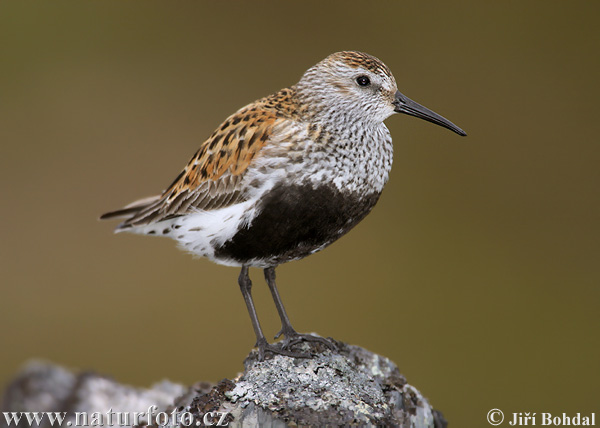
Adult Dunlin in breeding plumage. via: Nature Photo


Description

They are easily distinguished from other shorebirds by their unique alternate (breeding) plumage.  They have a bright orange/red color on the back and crown of head, and a dark black patch on the belly that extends behind the legs.  They are a bit harder to distinguish from other shorebirds when they are in their basic plumage.  The back is a dull brownish gray with brown streaking on the breast.  The black, slightly decurved bill and legs are also a defining feature.  In flight, they have a white wing-bar and white underwing.  In large flocks, Dunlins make rapid, synchronized maneuvers and it is a spectacular sight to see.  They use the coloration of their wings and those quick movements as a defense against aerial predators.  
Dulins in flight

Adult Dunlin, Basic (winter) plumage. via: Nature Photo


Diet

Dunlin forage by probing and stabbing their long bills in sand and mud.  During the breeding season, they forage for insects and insect larvae.  Otherwise, their diet is more varied and they feed on marine worms, small crustaceans, mollusks and sometimes small fish.   


Range/Habitat


Distribution of Dunlin in North America.
via: Birds of North American Online
Dunlin populations are pretty widespread geographically.  The populations familiarly seen in the US, breed in coastal tundra from eastern Canada to Alaska.  They begin their migration to breeding grounds in March and usually arrive in late May.  In September they molt and migrate from fertile areas around the breeding site to their wintering grounds.  Depending on the population, the range of migration is short to medium; but they are primarily found along mudflats, estuaries, marshes, sandy beaches, and shores of lakes and ponds in the northern hemisphere.  Some birds in northern Alaska (sub-species C. a. arcticola), will winter in parts of Asia.  In fact, a few birds that were banded by WCS in the past years, have been spotted in parts of Japan.  WCS also had geolocaters on a few birds and were able to recover some to map their migration routes.  Birds of North American Online states,
Despite the Dunlin’s broad geographic range, populations of several races appear to have declined in recent decades, perhaps because of continued loss and degradation of wetland habitats.
However, overall population trends still need to be established.  All migratory species have stopover sites and staging areas used for and during their migration.  A lot of those key habitats are protected but it is important to also look at a protection plan for the routes the birds take, rather than just a few key spots.  It is also possible the drop in populations could be caused by climate change as well as oil development.


Breeding/Nesting 

The males will arrive at the breeding grounds first and establish their territories.  Once the females arrive they build several scrapes in tundra grasses and display to attract a mate.  Most will re-pair with their mate from the previous year.  After courting, the female will choose one of the scrapes as the nest and finish building it.  They lay 4 eggs and usually incubate them from 20-22 days.  The eggs are generally an olive green color with brown or orange-brown spots all over the egg, and they are heavily spotted at the widest end.
Dunlin eggs in nest. via: ARKive
As a shorebird, they are precocial and once the eggs hatch the young are fully feathered and able to leave the nest.  They will stay with the parents and then form groups with other juvenile Dunlins.  The females will stay with the brood for six days and the males will remain in the area until they migrate once the breeding season is over.

Dunlin chick, via: m. geven